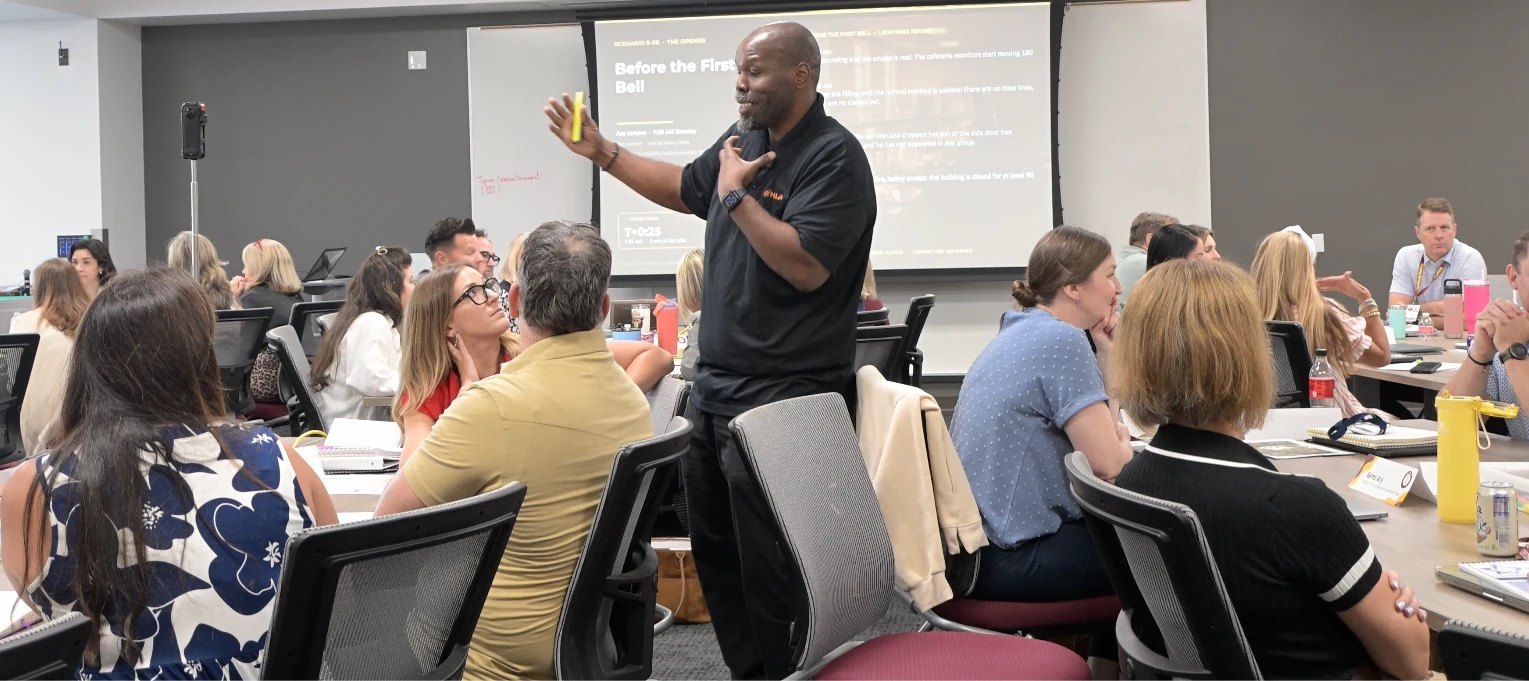
When law enforcement arrives — on average 30 minutes after an incident begins — your staff will have been managing it alone for 25 of those minutes. The Sentinel Series closes that gap with training built by someone who has been inside a building when it happened.
The National average law enforcement response time to an active school incident is approximately 30 minutes. The average violent school incident ends in under 5 minutes — which means law enforcement arrives after the situation has already been determined.
That leaves your staff — teachers, counselors, office staff, substitutes — holding the line for roughly 25 minutes with whatever training they received, whenever they last received it, from whoever delivered it.
Most districts train annually. A 45-minute session with a slide deck. Then they hope the staff remember what to do when the moment arrives.
The Sentinel Series was built for that 25-minute gap — because that gap is where outcomes are decided.
Each tier builds on the one before it. The Sentinel Series is always the primary engagement. Every other tier extends and sustains the investment your district makes in it.
23 modules + 5 Specials. The flagship curriculum. SRP-aligned, scenario-driven, practitioner-built. For every adult in the building.
16-week consulting engagement. 27 templates. SOGs, tabletop exercises, AAR reporting. The moment most districts get wrong, done right.
Seven written guarantees. A documented accountability framework for districts that want measurable commitments, not vendor promises.
11 keynote addresses, each with 14 production artifacts. For board meetings, staff development days, ESC convenings, and leadership institutes.
Digital site intelligence layer. Virtual walkthrough of your campus mapped to your SOGs. The spatial layer that completes the procedural work.
Organized by category. Delivered in any order. Each module includes a Participant Workbook and a Facilitator Guide. All 23 are SRP-aligned and scenario-driven.
Why safe schools become unsafe. The psychology of small things that compound.
Building the observer mindset — seeing and reporting before something breaks.
Where most incidents actually begin — the unlocked door and the unsupervised hallway.
The protocol most confused in practice. What it is, what it is not, and when to call it.
Beyond the drill. Decision-making under pressure when protocol meets chaos.
Knowing the difference — and which protocol your building can actually execute.
The moment most districts get wrong. The SRM framework that keeps families safe.
Drill evaluation that produces real change. What to measure. What to discard.
Keeping a safety culture alive after the first training year.
The commitment staff make — and the structure that keeps it.
How to think about concerning behavior. What separates a report from a file.
Building a campus leader who can dissect an incident and prevent the next one.
Training the brain to detect patterns before events. Research-grounded techniques.
The framework every district needs. What CSTAG teaches and what it misses.
Social media, device, and communication threats that schools did not sign up to manage.
When hesitation costs. How leaders build decision speed in their teams.
The coordination gap between school staff and first responders — and how to close it.
Safety protocols that account for every student, including the hardest to move.
Crisis communications before, during, and after.
What comes after the incident. The long recovery no district is ready for.
The internal governance structure that keeps safety alive beyond any single administrator.
Training for substitutes — the most underprepared group in every building.
When discipline data becomes a safety conversation — and what to do with what it reveals.
A Deep Dive in School Reunification — advanced scenario training for crisis teams and district coordinators.
A Critical Incident Review — case-study-driven examination of what was missed and when.
Workshop Edition of M-22 — extended training specifically built for substitute staff.
Working the Six Protocols Under Pressure — live scenario exercises for safety teams.
Building the Adult Habits That Hold a School Together — culture and mindset at the campus level.
For board meetings, staff development days, ESC convenings, and district leadership institutes. Practitioner voice. No slides full of statistics without context.
The Little Things That Lead to Big Problems
Three Words That Save Lives or Cost Them
What You Scan For Is What You See
Indecision Is a Decision Whether You Made It On Purpose
You Do Not Need Motivation, You Need a Reason
Your Plan Should Not Depend on One Deputy's Cell Phone
Why School Safety Programs Die in Q2
When Discipline Data Becomes a Safety Conversation
Only Your Staff Can Interrupt
Pricing is discussed on the discovery call — every district's situation is different. All three tiers include the full Sentinel Series curriculum package and are eligible for BSCA, Title IV-A, and Texas HB 3 funding.
Two modules delivered on-site. Foundation modules or your selection. For districts that want to see the curriculum in action before committing to the full program.
The complete 23-module curriculum delivered over one full school year, sequenced to your district calendar, with a dedicated facilitator track for your internal safety team.
Full curriculum plus Reunification Services and Sentinel Compact — the complete three-tier engagement for districts that want the full program covered in year one.
Multi-campus districts receive per-campus rates discussed on the discovery call. All tiers eligible for BSCA Stronger Connections, Title IV-A, and Texas HB 3 funding.
Three federal and state funding mechanisms were designed to pay for exactly this kind of training. Most districts are not using all of them.
Bipartisan Safer Communities Act funding specifically designated for school safety and mental health. Districts that have not yet obligated these dollars have a hard deadline of September 30, 2026. Funds may be used for professional development, curriculum, and consulting services.
Check Your District's BalanceTexas school safety allotment established under HB 3 and strengthened under SB 57. Allocated annually per district based on ADA and campus count. May be used for safety training, audits, and professional development programs aligned to the Texas School Safety Center standards.
Student Support and Academic Enrichment grants are available to every district receiving Title IV-A funds. School safety professional development is an explicitly allowable use. Many districts park Title IV-A funds without fully utilizing the safety development allowance.
Schedule Funding Conversation
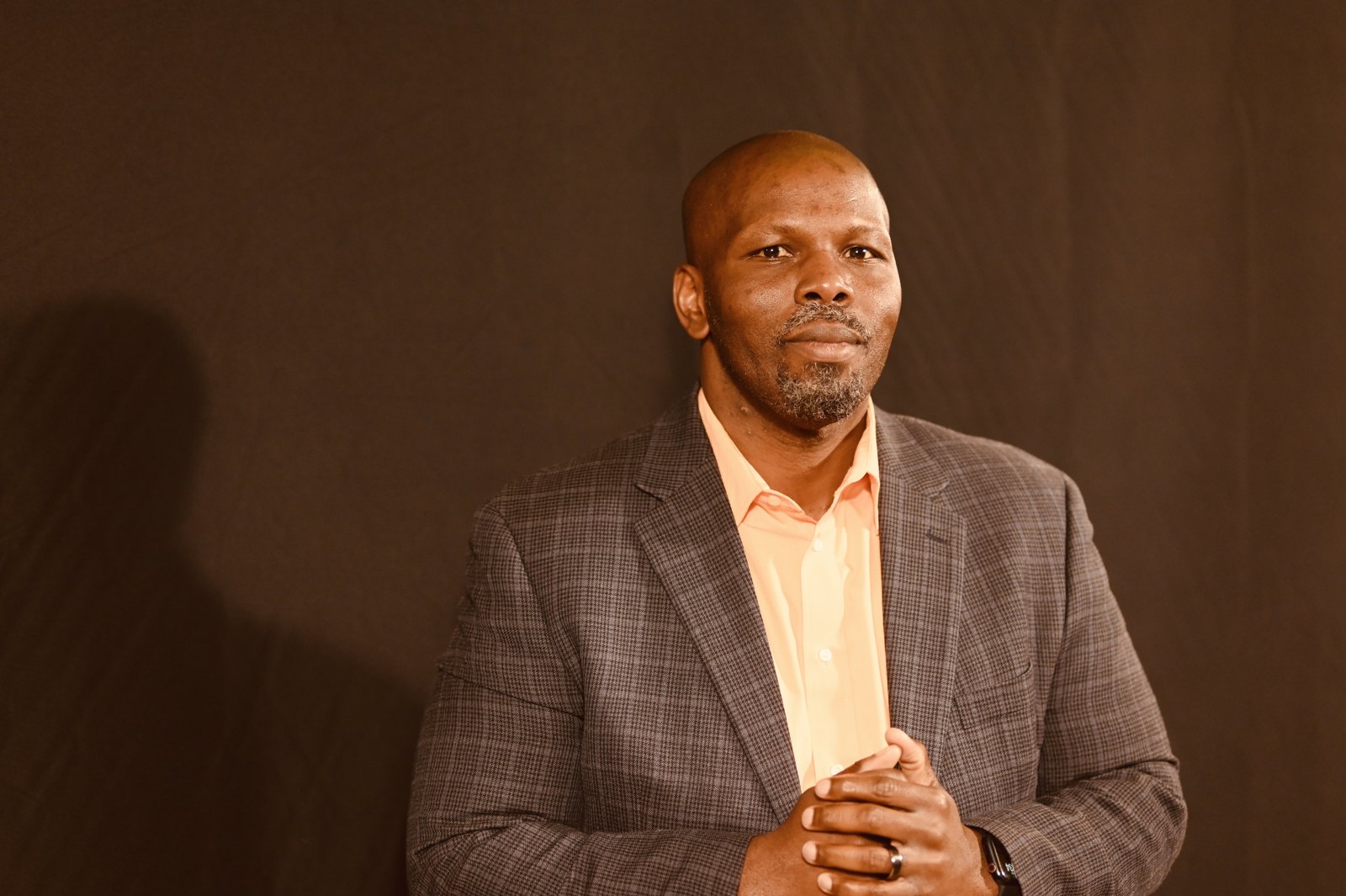
Michael Peck spent 23 years in Texas public education running campuses, leading safety teams, participating in actual critical incident responses, and watching how training fails under pressure when it was built on slides instead of scenarios.
He did not build the Sentinel Series from a conference room. He built it from the inside — from every drill that fell apart, every call he fielded at midnight, every moment he saw a staff member freeze because no one had taught them what to actually do.
"I spent 23 years inside Texas public education. I know what it looks like when a drill falls apart because staff were trained on slides, not scenarios."
— Michael Peck, M.Ed., MBA · Founder, High Impact ProgramsPick a time, share where your district is, and we will have an honest conversation about whether the Sentinel Series is the right fit — and if it is, what funding covers it.
281-203-7810 · Peck@highimpactprograms.com · Houston, TX · M–F 8am–6pm CT